October 15, 2026
The Death of Public Trading
Sanford Grossman and Joseph Stiglitz published "On the Impossibility of Informationally Efficient Markets" in 1980. Information costs money to collect. If prices already reflected everything, nobody would pay to collect it, and if nobody collects it, prices can't reflect it. So a market never becomes perfectly efficient. It settles where the traders who pay for information earn just enough extra return to cover the cost.
I've been thinking about what happens to that equilibrium when the cost of producing and processing information falls toward zero. My conclusion is that trading as most people picture it, a person beating the market because they know something first, stops paying in public markets. Markets won't close; the title is a slight hyperbole ;) However, the profit from knowing first moves to two places: the companies that own the information, and the markets where information is still expensive to get.
For most of the last century, the edge was physical. Researchers at the University of Michigan and the University of Chicago found that US mutual fund managers overweight companies headquartered near them and earn abnormal returns on those local holdings; the local stocks they held beat the local stocks they skipped by roughly 3% a year, risk adjusted. Proximity was information, which is a big reason trading clustered in Chicago, New York, London and other financial hubs. Regulation took the first swing. Reg FD, in 2000, stopped companies from handing material news to favored analysts before everyone else. Machines took the second. US equity HFT revenue fell from about $7.2 billion in 2009 to about $1.1 billion in 2016, per Tabb Group. Calmer markets after the crisis helped, but the bigger driver was that every firm bought the same microwave links and the speed edge competed itself away. That is the Grossman-Stiglitz paradox in action: the edge is real, then cheap, then crowded, then worth about what it costs.
The scoreboard for human stock picking already reads that way. In 2025, 79% of active large-cap US equity funds trailed the S&P 500, and over 20 years the figure is close to 93%. Those numbers are net of fees, which is exactly the point of the paradox: whatever gross edge exists roughly pays for the effort, and not much more. Apollo's research team now describes public markets as largely a source of beta.
Now picture a public company in 2040. Agents inside it close deals, ship features and report to each other at the speed of the internet, so the company already holds a live, structured log of its own operations. Publishing a machine-readable slice of that log costs almost nothing. The reason to publish is cost of capital. Research from the University of Chicago and Wharton on disclosure argues that reducing information asymmetry improves liquidity and lowers the cost of capital. If I am Nvidia and I want long-term holders paying a full multiple, I give them a live view of the business so they stop discounting what they can't see. Competitors who want the same investor attention follow.
Mandatory filings stay the floor. Above that floor, the granular data gets sold. x402 lets an agent pay for a single HTTP request in stablecoins, with no account or API key, and it has already processed well over a hundred million payments. Cheap decision models make the other half of the loop cheap: Cloudflare's Clef, released on October 1 with open weights as an open source replacement for TypeSafe's Jev, runs at roughly $0.24 per million input tokens on Workers AI. Put them together and trading agents pay issuers, per call, for operating data. Securities law shapes how. Reg FD bans selective disclosure of material nonpublic information, so a paid feed either has to be open to anyone on equal terms or limited to granular data that is immaterial on its own, the mosaic analysts are already allowed to assemble. I expect the second, and I expect the SEC to have opinions about where that line sits. The company sells the tiles.
In Grossman-Stiglitz terms, the issuer becomes the seller of information, and the price of information becomes issuer revenue. The informed trader's excess return shrinks to the fee it paid for the feed, while the rent that used to go to whoever had the best rolodex goes to whoever owns the data.
There is a second-order effect I find interesting. x402 settles onchain. If my agent buys a feed and trades seconds later, both the payment and the trade are visible, and every agent watching the chain can copy the trade. Copying pushes the price to fair value faster, which shrinks my profit further. Buyers will answer with shielded payments and zero knowledge proofs of payment (my favorite tools :)), and that will buy them a little time. Either way, the half-life of an edge keeps shrinking.
Faster hardware speeds up the trip, and quantum computing, if it arrives in useful form, only compresses the timeline. Agents reading the same public data converge on the same price at the same moment. What remains is the thin margin Grossman and Stiglitz predicted: enough to pay for the data and the compute, with nothing left for a person clicking buy on a phone.
So what actually dies? Investing doesn't. Owning the index still earns the equity risk premium, which is payment for bearing risk rather than for knowing things, and efficient prices don't erase it. Market making survives as a thin-margin utility. What dies is the human edge in information-driven speculation on public markets: the kind of trading Wall Street grew up around, and the kind most of us know from forex and Robinhood.
That edge moves to where information is expensive to produce and no single issuer can broadcast it. Private markets are the clearest case. A private credit deal is underwritten from data rooms, site visits, covenants and relationships. AI will make that diligence cheaper too, but access remains limited, and an agent can't analyze what it isn't allowed to see. The dispersion of returns shows it. Moonfare measured a 19.2 point gap between top and bottom quartile private equity managers from 2016 to 2026, against 2.9 points in large-cap public equities, and top quartile managers repeat about a third of the time, above the quarter you'd expect from luck. Apollo puts the top-to-bottom decile gap at almost 30% in private equity versus about 2% in public equities, with a similar pattern in private versus public credit. Wide, persistent dispersion means diligence still changes the outcome. Private credit alone is now estimated between $1.7 trillion and $3.5 trillion, depending on what you count.
Rates hold up for a different reason. Much of the return there comes from holding duration, carry and liquidity risk, which is a risk premium rather than an informational edge, so efficient prices don't arbitrage it away. Rates are still plenty speculative (the Treasury basis trade is one of the most levered positions in finance), but the core return is anchored in balance sheet, not in knowing first.
The migration has already started. The number of US listed companies peaked in 1996 and has roughly halved since. Jay Ritter's IPO data tells the same story.
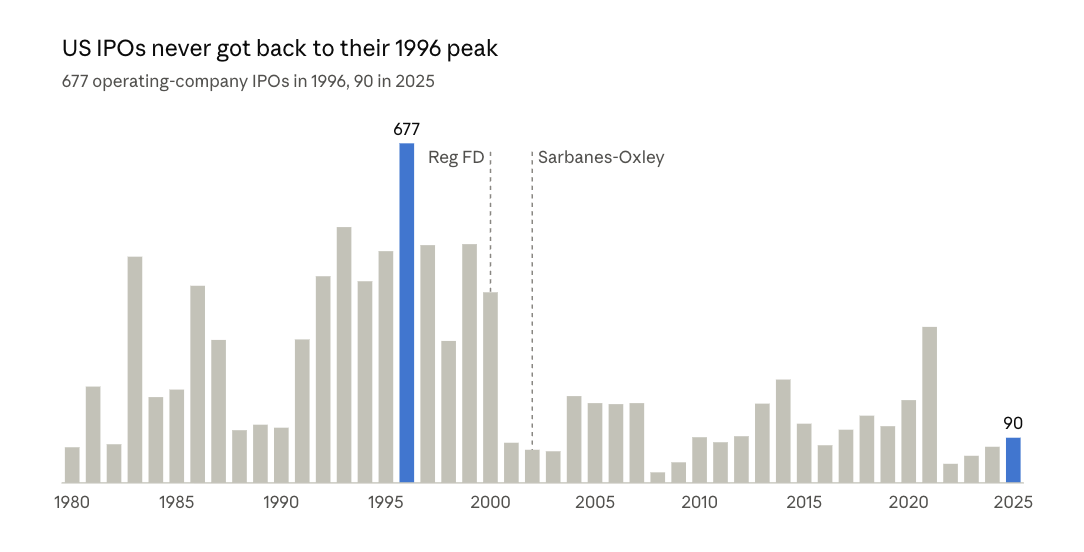
AI didn't cause that decline. Compliance costs, abundant private capital and acquisitions by larger public companies did most of the work. However, those causes share a root with this argument: being public means giving your information away, and private capital lets you keep it. AI makes the giveaway cheaper and faster, which pushes more companies, and the edge that comes with them, into private hands.
I was talking with someone about Sereel the other day, and they showed me tokenized Nvidia stock on Binance and xStocks, looking for a comparison. I explained this theory to them, because it's the reason Sereel focuses on tokenizing private markets. The private space is more exciting to me because it has more elegant tools for trading information asymmetry. For example, trading a private equity note requires real expertise, and leaving all of that speculation to agents will remain unsafe.
If you trade public equities for a living, the useful question is what you know that an agent can't buy for a fraction of a cent. If the answer is nothing, index the public book and spend your edge where data rooms still exist. The original paper is short and worth an afternoon.